Arturo Fasciolo
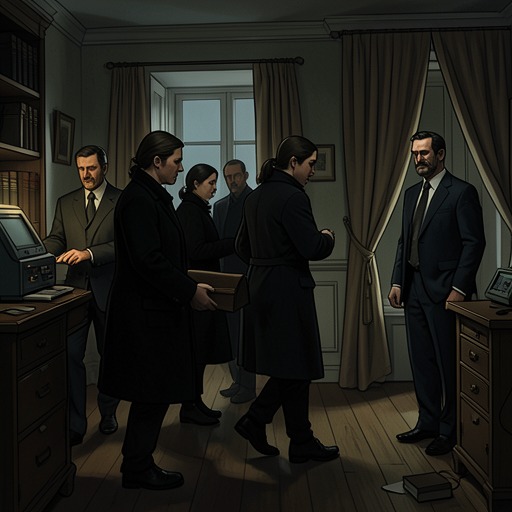
M: Son of the CenturyArturo Fasciolo is Benito Mussolini’s private secretary, typist, and personal stenographer at Palazzo Chigi. In the aftermath of Giacomo Matteotti’s abduction and killing, his position at the prime minister’s desk makes him a channel through which incriminating objects and information reach Mussolini. Fasciolo is ordered to keep silent, but instead tells Cesare Rossi what he has learned; the following day, he delivers a passport from Amerigo Dumini and answers Mussolini’s questions about the burial. He does not direct the operation, but his acts of delivery and disclosure help reveal how closely the government’s inner circle is connected to the effort to contain its consequences.
Position at Palazzo Chigi
The evidence identifies Fasciolo as Mussolini’s private secretary, typist, and personal stenographer. His work places him in immediate proximity to the prime minister’s office and gives him access to exchanges that would otherwise remain private. In the account of the Matteotti affair, this routine official position acquires a different weight: Fasciolo is present not as a public spokesman but as the person who handles material objects brought into the office and carries information back out of it.
The sequence also places him among several figures whose roles intersect with the Fascist Cheka and the management of political violence. Cesare Rossi’s January 1924 letter to Mussolini requested a permanent railway pass for Amerigo Dumini, explaining that Dumini often travelled to carry out assignments from Rossi, Aldo Finzi, or others. Later, Giovanni Marinelli protected his authority as head of the Fascist Cheka alongside Rossi. These details establish the wider network surrounding the affair, but the account does not identify Fasciolo as a participant in those earlier arrangements. His documented part emerges when the evidence begins to pass through the prime minister’s office.
The wallet and the breach of silence
On the evening before the events described in Rome on June 11, Fasciolo encountered Albino Volpi at the Picarozzi bar in the Galleria Colonna. Volpi, a former Ardito, told him what had happened and handed him Matteotti’s wallet. The next morning, at about nine, Fasciolo stood before Mussolini’s desk at Palazzo Chigi. The wallet, encrusted with dried blood, lay between the two men. Mussolini took it, opened a drawer, and put it away.
Fasciolo was instructed not to broadcast what he had learned. Yet after leaving the office, he encountered Rossi and, shaken by the encounter, told him about the wallet. That disclosure broke the requested silence and set off a chain of responses beyond the private office. Rossi went to Marinelli; their conversation became heated, and Rossi then sought out Filippo Filippelli. The sequence shows Fasciolo acting as an unwillingly pivotal intermediary: information passed to him by Volpi did not remain in his hands, and the attempt to confine it to Mussolini’s office immediately faltered.
The passport and the grave
The next day, after the afternoon newspapers had begun reporting the case, Fasciolo again met with Mussolini. This time he presented a passport he had received directly from Dumini. Mussolini protested that the document should not have been brought to him because, by then, Rome already knew of the affair. Nevertheless, he took the passport and placed it in the same desk drawer as the wallet.
Before dismissing Fasciolo, Mussolini asked about the burial, specifically its location, size, and covering. Fasciolo’s role here is distinct from his first delivery: he is not merely bringing an object into the office but answering questions that disclose the prime minister’s private concern with the grave. The account gives no further detail about how Fasciolo acquired the passport or what he knew beyond what he conveyed. It does establish that the document came from Dumini and that Mussolini received it while publicly presenting himself as seeking the missing deputy.
Narrative significance
Fasciolo’s importance lies in the contrast between the modest scope of his office and the consequences of what passes through it. The wallet and passport are tangible evidence; his brief disclosures connect those objects to the people surrounding Mussolini. Each delivery sharpens the contradiction between private knowledge and public posture. In Parliament, Mussolini described the abduction as a crime and promised that investigators would pursue the perpetrators, while already asking Fasciolo about the grave. Fasciolo does not make that contradiction by himself, but his presence at the desk, his breach of silence, and his answers help make it visible.
The narrative presents him through a compact sequence of actions rather than an extended account of his motives or personal life. Volpi entrusts him with the wallet; he brings it to Mussolini; he tells Rossi despite the instruction to keep quiet; then he brings Dumini’s passport and supplies information about the burial. The accumulating objects and messages turn the secretary’s office into a point where the concealed operation and the government’s public response meet. Fasciolo’s documented significance is therefore not command but transmission: what he carries, and what he chooses to tell, exposes the widening reach of the affair into the heart of the government.